
Most 3D printing filaments are hygroscopic, meaning they actively absorb moisture from ambient air. Even a few days of exposure in average room humidity can noticeably wet your spool. When wet filament enters a 200°C+ hotend, trapped water rapidly boils into steam, resulting in stringing, rough surface textures, layer delamination, and brittle prints.
This issue actually creates two needs: drying wet filament and keeping unused filament dry. These are often addressed with filament dryers and dehumidifier cabinets. In this guide, we will break down their working principles, key differences, and how to choose the right setup for your 3D printing needs.
Filament Dryer: Active Thermal Moisture Removal
A filament dryer is designed for one primary goal: active moisture extraction. It is an active, restorative solution for spools that have already absorbed ambient moisture.
Core Principle
Ambient moisture doesn’t just sit on the filament’s surface; water molecules bind deeply within the polymer chains. A filament dryer uses thermal energy to break these molecular bonds and evaporate the trapped moisture.
Working Logic
Specifically, the filament dryer uses PTC heating elements and internal circulating fans to warm the entire chamber to target temperatures (typically 45°C–70°C+ depending on material). As heated air sweeps across the spool, it strips moisture away and vents the humid air out through exhaust ports. Many models also include PTFE pass-through tubes, allowing you to feed filament directly into your extruder while actively heating.
Intended Uses
A filament dryer is particularly useful for reviving saturated spools that have been left exposed on open shelves and for providing immediate, pre-print thermal conditioning. It can also maintain heat throughout multi-day prints, helping prevent the filament from re-absorbing moisture during extended printing.
Target Users
It is well suited to hobbyists and creators who typically work with one to four active spools and need filament ready to print on demand.
Filament Dehumidifying Cabinet: Long-Term Low-Humidity Storage
A filament dehumidifying cabinet serves a fundamentally different purpose: continuous, preventative moisture management.
Core Principle
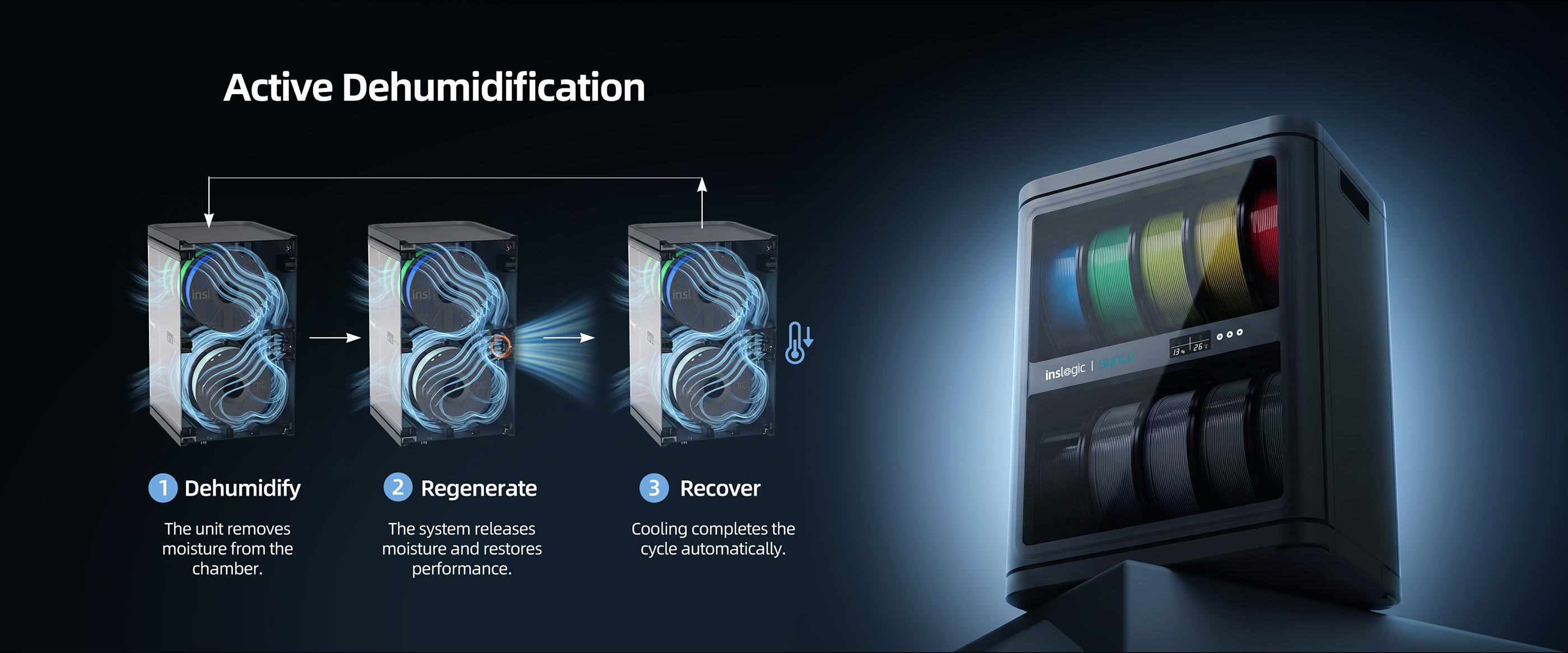
Dehumidifying is about preservation, not baking. Its goal is to maintain an ultra-low relative humidity (RH) environment (<15% RH) at room temperature, ensuring dry filament does not have the opportunity to absorb moisture.
Working Logic
The cabinet uses molecular sieve physical adsorption paired with an intelligent cycling system. High-grade molecular sieves actively trap airborne water vapor within the sealed cabinet. Through an automated, smart regeneration cycle, the system periodically vents the captured moisture outside the unit—all while keeping the internal storage compartment at a steady, unheated room temperature.
Intended Uses
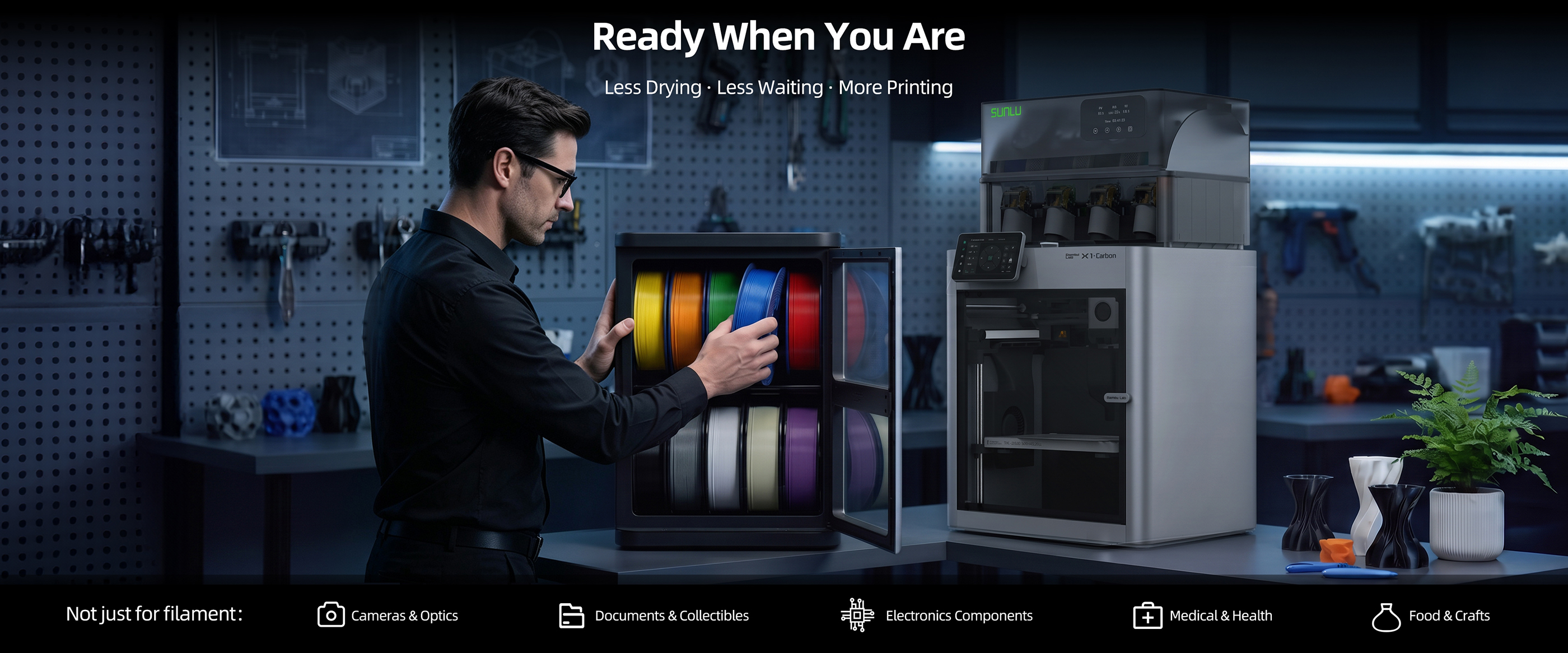
A dehumidifying cabinet is designed for long-term filament storage, keeping dry filament ready for use between prints. It is particularly useful for spools that may sit unused for days or weeks and need protection from ambient humidity.
Target Users
A dehumidifying cabinet is suited to makers with growing spool libraries, as well as studios and print farms managing dozens of open rolls across different colors and materials.
Why Not Just Use Sealed Bags or Store Spools in a Dryer
One may ask: why not just stick to traditional storage bags or keep spools inside a heated dryer box?
This is because both approaches present distinct practical limitations for day-to-day use:
l Limitations of Sealed Bags & Desiccants: Vacuum bags can puncture easily, ziplock bags may lose their seal over time, and silica gel packs eventually become saturated without providing a clear indication. A dehumidifying cabinet maintains a consistently dry environment without requiring users to repeatedly replace or monitor desiccants.
l Drawbacks of Continuous Dryer Use: Keeping a thermal dryer running 24/7 consumes more electricity and exposes filament to prolonged heat, which may contribute to thermal fatigue or spool deformation over time. A dehumidifying cabinet provides room-temperature storage without continuous heating, making it more suitable for long-term filament preservation.
Filament Dryer vs Dehumidifier Cabinet
| Filament Dryer | Dehumidifier Cabinet | |
| Working Principle | Thermal heating + active air circulation & venting | Physical adsorption + intelligent cycling |
| Core Goal | Evaporate deep moisture & enable direct-feed printing | Long-term ambient prevention & low-humidity storage |
| Operating Temperature | Heated (45°C – 70°C+) | Ambient / room temperature (no heat damage) |
| Capacity | Lower capacity | Higher capacity |
| Usage Cycle | Intermittent / batch runs (4–12 hours per session) | 24/7 continuous, permanent operation |
| Spool State | Treats already-wet spools | Keeps dry/baked spools factory-fresh |
| Energy Impact | Moderate (100W–300W during active heating) | Ultra-low (~10W–30W standby/cycling) |
| Best Application | Pre-print preparation & active print feeding | Spool inventory library & bulk material preservation |
| Target Users | Restore moisture-affected filament and quickly return it to a printable condition. | Focus on long-term storage and daily filament management to help reduce moisture reabsorption. |
How to Choose the Right Setup
The right setup depends less on personal preference and more on two concrete factors: what materials you print, and how much filament you keep in rotation.
1. Material
Regular Materials (PLA, PETG): Moderate moisture absorption. A compact filament dryer is often enough for occasional baking before demanding print jobs.
Engineering & Highly Hygroscopic Materials (TPU, PA/Nylon, PC, PVA): Extreme moisture sensitivity. Nylon and PVA can degrade print quality after just 4–6 hours of open-air exposure. These materials require active drying in a heated unit plus long-term storage in a dry cabinet.
2. Inventory & Scale
Individual Makers: A 1- or 2-spool dryer covers daily routines.
Studios & Multi-Color Enthusiasts: A dehumidifier cabinet eliminates the headache of having 10+ open spools absorbing moisture simultaneously.
Print Farms & Industrial Workshops: Both are essential to guarantee batch repeatability and minimize failed prints on engineering-grade parts.
SUNLU Filament Drying and Dehumidifying Solutions
At SUNLU, we provide both filament dryers and dehumidifying cabinets to address different filament moisture management needs.
Our SUNLU Filament Dryer is designed to actively dry filament that has already absorbed moisture. We offer different configurations, including the SUNLU AMS Heater and SUNLU AMS Lite Heater, which use controlled heating to help remove moisture from filament before and during printing. These solutions are suitable for makers who need to condition filament before demanding print jobs or keep filament dry while printing.
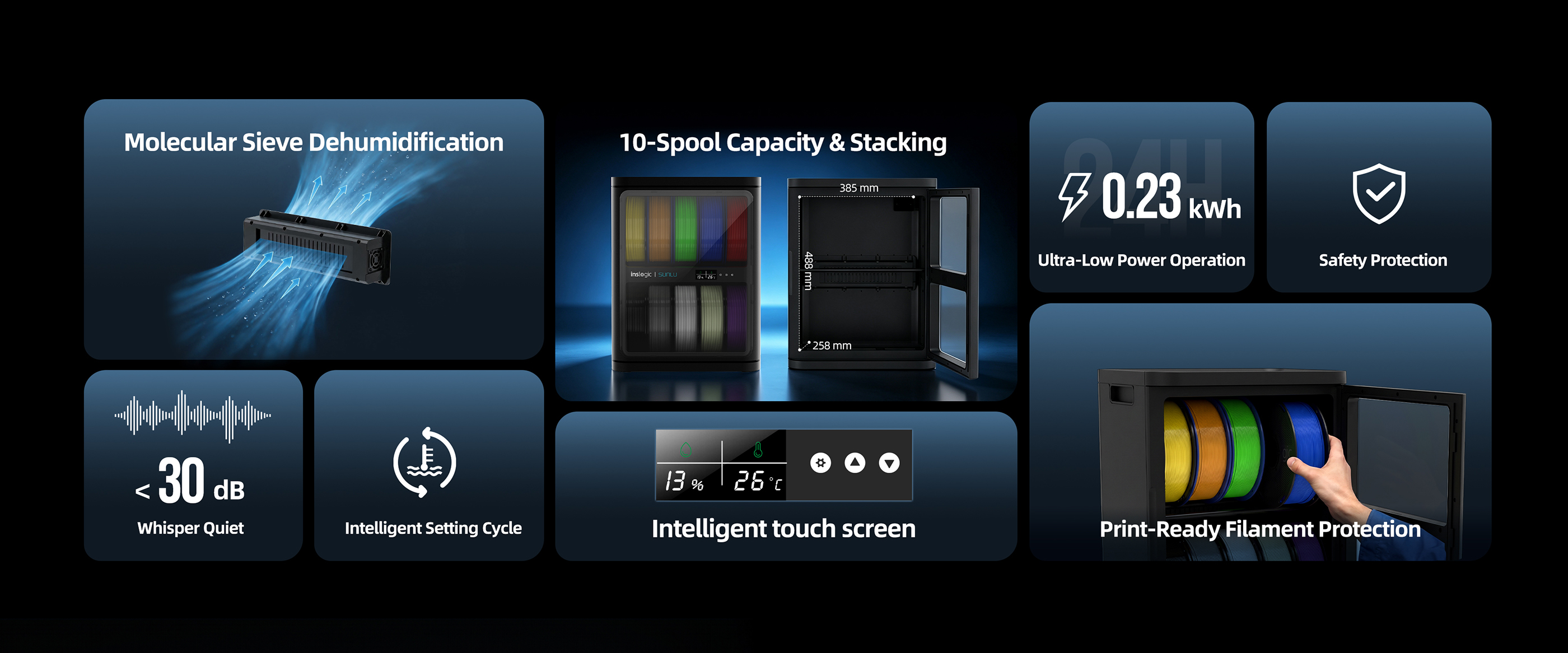
For long-term storage, our SUNLU i10 Filament Dehumidifying Cabinet takes a different approach. Instead of continuously heating the filament, it maintains a low-humidity environment at room temperature to help prevent dry filament from absorbing moisture during storage. Its larger capacity also makes it suitable for users managing multiple spools.
With both heated filament drying and low-humidity storage solutions, we offer options for different filament conditions, usage patterns, and storage requirements.
Conclusion
Choosing between a filament dryer and a dehumidifying cabinet depends on whether the goal is to remove existing moisture or prevent moisture from returning. A dryer uses heat to restore wet filament, while a dehumidifying cabinet maintains a low-humidity environment for long-term storage. At SUNLU, we offer solutions for both needs, helping makers keep their filament dry, protected, and ready for reliable 3D printing. Browse our 3D printing filaments and filament accessories to find the right fit for your setup.