

The build plate (also known as the print bed) is the surface on which a 3D printer creates objects layer by layer. It plays a critical role in print quality, first-layer adhesion, and overall print success.
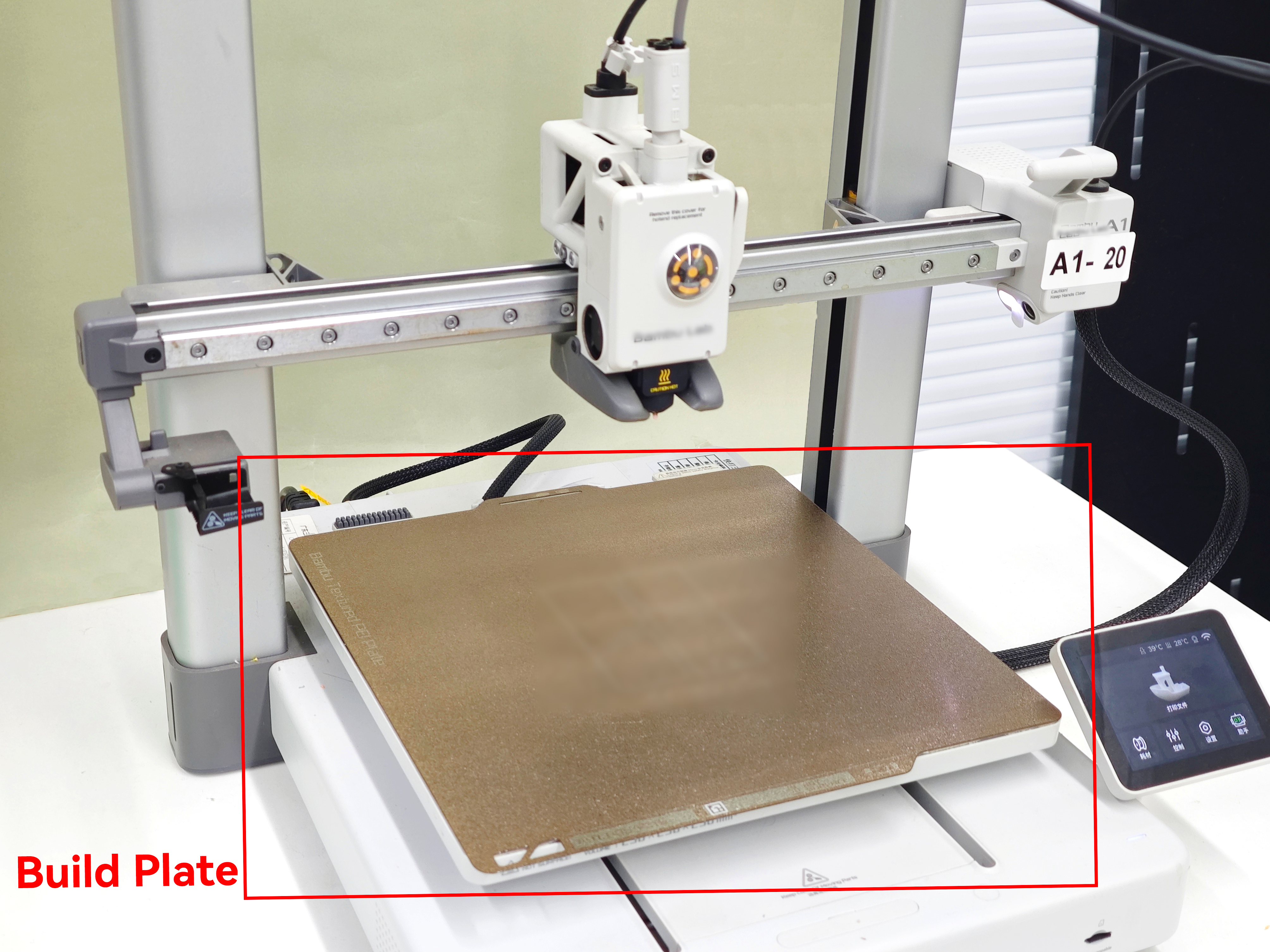
Functions of the Build Plate
- Supports the first layer: Essential for achieving a successful first layer.
- Maintains positional accuracy: Keeps the model fixed in place during printing.
- Affects surface finish: The texture and material of the plate influence the appearance of the bottom surface.
- Temperature control (for heated beds): Maintains a stable temperature to reduce warping.
Types of Build Plates
Non-Heated Build Plate
A basic platform without temperature control, typically used for easy-to-print materials such as PLA.
- Simple structure, Lower cost
- Limited material compatibility
- Higher risk of poor adhesion with engineering materials
Heated Build Plate
A platform equipped with heating elements to maintain a controlled temperature.
- Improves adhesion and reduces warping
- Essential for materials like ABS, PETG, and Nylon
- Standard on most modern FDM 3D printers
Common Build Surface Materials
Glass Plate
A rigid, non-metallic surface with a smooth and flat finish. It can produce a glossy, mirror-like bottom surface on prints. Glass itself does not generate heat and is typically placed on top of a heated aluminum bed or paired with a heating element underneath. It is usually secured with clips.
Pros:
- Smooth and flat surface for high-quality bottom finishes
- Easy to clean
- Scratch-resistant and durable
Cons:
- Slow heat transfer and longer preheating time
- Not flexible; requires a scraper for part removal
Compatible Materials:
PLA can be printed directly on top of a glass plate. For PETG, ABS, Nylon, and similar materials, it is recommended to apply glue (glue stick or spray) or use masking tape.
Rigid Metal Plate (Aluminum / Stainless Steel)
Rigid metal plates are commonly used as the base of heated beds. Aluminum plates are widely used due to their excellent thermal conductivity, but bare metal surfaces provide poor adhesion and typically require additional surface treatments such as PEI sheets or adhesives.
Pros:
- Excellent thermal conductivity
- Good flatness control
Cons:
- Very poor adhesion when used bare
- Aluminum plates are not magnetic and require clips; stainless steel plates can be magnetic but are heavier
Compatible Materials:
When used on their own, most materials require glue or tape. With surface coatings applied, compatibility depends on the coating material.
Spring Steel Sheet (Flexible Build Plate)
A spring steel sheet is a flexible, magnetic build plate base. It attaches to the heated bed via a magnetic layer underneath. Its key advantage is easy part removal—prints can be detached simply by bending the plate, eliminating the need for a scraper.
Spring steel sheets themselves do not provide sufficient adhesion and must be used with surface coatings. In practice, they are commonly used as a composite system (spring steel + coating). Coating names such as PEO or PEX may vary by manufacturer and are not strictly standardized.
Pros:
- Removable and flexible for easy print removal
- Magnetic attachment for convenient installation
Cons:
- Coatings are consumable and may wear over time
Common Coating Types for Spring Steel Sheets:
1. Textured PEI Coating
A powder-coated textured PEI (Polyetherimide) surface with a fine granular finish. It provides reliable adhesion for a wide range of materials without additional adhesives in most cases. Prints typically release automatically after cooling.
Compatible Materials:
PLA, TPU, PETG can be printed directly on a PEI sheet. For high-temperature materials such as ABS, ASA, PA, and PC, applying a thin layer of glue is recommended.
2. Smooth PEI Coating
A smooth PEI film that provides strong adhesion and a glossy bottom surface finish.
Compatible Materials:
PLA, ABS, and ASA can be printed directly on a smooth PEI sheet. PETG is strongly recommended to use with a release agent or switch to textured PEI. TPU can be printed directly but may adhere too strongly.
3. PEO Coating
A functional coating (commonly referred to as PEO, though definitions vary by manufacturer) designed to balance adhesion and release, especially for materials like PETG.
Compatible Materials:
PETG and TPU typically do not require additional adhesives. Adhesion for PLA may be weaker depending on the product.
4. PEX Coating
An engineering-grade coating (commonly referred to as PEX) focused on high-temperature resistance and wear durability, suitable for demanding applications.
Compatible Materials:
PETG, ABS, ASA, and other high-temperature materials. Performance depends on the specific formulation.
5. PP Coating
A specialized coating designed specifically for polypropylene (PP), addressing its notoriously poor adhesion.
Compatible Materials:
PP and PP-based composites. Adhesion to PLA and PETG is generally poor.
6. Nylon (PA) Coating
Designed to improve adhesion stability for nylon materials while reducing warping and edge lifting.
Compatible Materials:
PA (e.g., PA6, PA12), as well as reinforced nylons such as PA-CF and PA-GF.
7. BuildTak-like Surface Sheets
BuildTak-style sheets are adhesive-backed functional films made from heat-resistant polymers with micro-textured surfaces to enhance first-layer adhesion.
Compatible Materials:
Suitable for PLA, ABS, and PETG. TPU may adhere too strongly.