
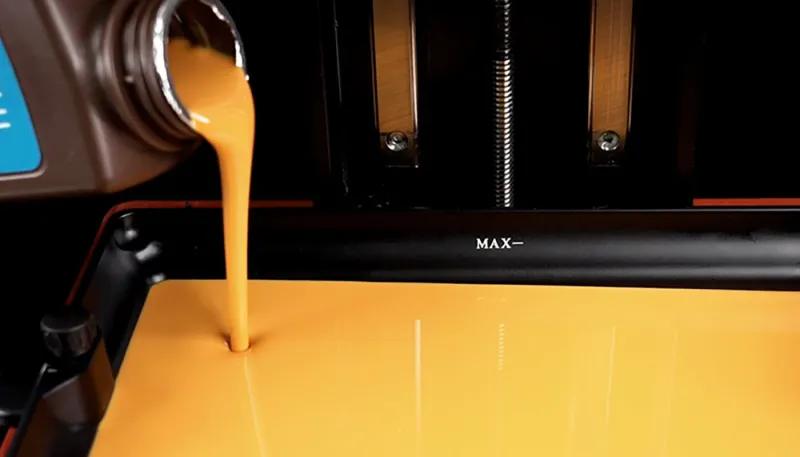
Resin 3D printing has become widely popular among hobbyists, designers, engineers, and model makers with its capability to produce smooth surfaces and fine details. It suits miniatures, prototypes, jewelry models, decorative parts, and components with small or complex features.
But what exactly is resin 3D printing? How does it turn liquid into a solid object? Which resin should you choose? This guide answers these questions and explains everything you need to know before getting started.
What Is Resin 3D Printing?
Resin 3D printing is an additive manufacturing process that uses ultraviolet light to convert liquid photopolymer resin into solid plastic. The printer creates the object one thin layer at a time from a digital 3D model. Unlike FDM printing, which melts and deposits filament materials, resin printing relies on light curing technology to achieve finer details, smoother surfaces, and higher precision.
The main vat photopolymerization methods include SLA, DLP, and MSLA. SLA typically uses a laser to trace each layer. DLP projects a complete layer image, while MSLA directs UV light through an LCD mask. The light systems of these methods differ but they all cure selected areas of liquid resin.
How Does Resin 3D Printing Work?
The process starts with a digital 3D file. Slicer software can divide the model into thin layers and calculate supports, orientation, and exposure settings. The user then fills the printer vat with compatible liquid resin.
In a common desktop LCD printer, the build plate lowers toward the transparent film at the bottom of the vat. UV light passes through the LCD screen and hardens the shape of the first layer. The plate then lifts slightly so fresh resin can flow beneath the cured material. The printer repeats this cycle until the complete object forms on the build plate.
The printed part still requires post-processing. A wash can remove uncured resin from the print’s surface. Standard resins should be cleaned with isopropyl alcohol (IPA) or a compatible resin cleaner, while water-washable resins can be cleaned with water. After drying, the part is exposed to UV light to complete the curing process and achieve its intended mechanical properties. Supports can then be removed, and any support marks can be sanded or finished as needed.
Throughout the process, users should wear suitable gloves, ensure adequate ventilation, and follow all resin safety guidelines. Uncured resin, contaminated solvent, and used wash water should not be poured down household drains. Always dispose of these materials according to local waste regulations.
Types of Resin Used in 3D Printing
There are many types of 3D print resin, each type having different properties and applications.
l Standard resin provides crisp detail, a smooth finish, and straightforward print settings. It’s a solid choice for display models, figurines, visual prototypes, and general hobby projects, though standard resins tend to be more brittle than functional ones.
l Toughness resin offers greater impact resistance and durability, making it well suited for enclosures, brackets, tools, and prototypes that need to withstand moderate stress.
l Flexible resin produces parts that can bend or compress. Common applications include grips, soft-touch parts, seals, wearable prototypes, and components requiring elasticity. Flexible resin often calls for careful support placement and finely tuned exposure settings.
l Water-washable resin lets users clean surface residue with water instead of isopropyl alcohol, simplifying cleanup. The resulting wash water still contains resin and requires responsible disposal.
l Engineering resin is formulated for specific technical needs, offering properties such as high heat resistance, stiffness, toughness, or low deformation depending on the formula. Users need to match the resin’s technical data to their printer and application.
How Resin Quality Impacts Print Results
Low-quality resin can undermine the accuracy, appearance, and strength of a print.
Dimensional accuracy suffers first. Inconsistent formulas shrink unpredictably and cure unevenly, which throws off holes, walls, joints, and other mechanical features. The result is often warped surfaces, incorrect dimensions, or parts that don’t fit together properly during assembly.
Aesthetics take a hit too. Sediment, contamination, or an unstable resin mixture can cause color variation, blotchy patches, and loss of fine texture. Edges that should be crisp can come out soft or uneven.
Structural integrity is where poor resin quality shows up most seriously. Uneven curing weakens the bond between layers, leaving parts prone to cracking, delamination, or premature failure under stress.
SUNLU Provides High-Quality Resin for 3D Printing
At SUNLU, we offer a broad selection of high-quality resin for common LCD, DLP, and SLA applications. Our range includes Standard Resin, Standard Plus Resin, Water-Wash Standard Resin, ABS-Like Resin, Water-Wash ABS-Like Resin, Toughness Resin, Flexible Resin, PA-Like Resin, High Clear Resin, and High Temperature Plus Resin.
This variety helps you select a formula based on detail, cleanup method, flexibility, toughness, clarity, or heat resistance. For example, our Water-Wash Standard Resin supports water cleanup and produces rigid models with clear details. Our Toughness and ABS-like options suit parts that require more durability than conventional standard resin, while our specialized products meet a range of visual and functional needs.
Before use, check your printer’s wavelength requirements and the recommended exposure settings. Shake the sealed bottle as directed and print a small calibration model first. These steps help you achieve consistent results with SUNLU 3D print resin.
You can also join the SUNLU Community to ask questions, share your 3D projects, and learn from other 3D printing enthusiasts.
Conclusion
Resin 3D printing uses controlled UV light to build precise plastic objects from liquid photopolymer resin. Its smooth finish and fine detail make it useful for models, prototypes, artistic pieces, and specialized components. For consistent and reliable results, choose high-quality resin that matches your application. Explore SUNLU’s range of 3D print resin to find the right material for your next project.