
Regular filaments such as PLA and PETG work well for prototypes, decorative models, and many everyday prints. However, these materials may not be suitable for engineering components. Engineering components often need to carry continuous loads, maintain precise dimensions, resist heat, or remain stable during long-term use. These requirements call for filaments with enhanced mechanical and thermal properties.
That's where carbon fiber reinforced filaments come in. These filaments can produce parts with higher stiffness, better dimensional stability, and improved strength-to-weight performance.
How Does Carbon Fiber Reinforce 3D Printing Filament?
In carbon fiber reinforced filaments, short, chopped fibers are mixed into a thermoplastic matrix to enhance the material’s mechanical properties.
For example, PA6-CF contains 20% carbon fiber.carbon fiber can help resist bending and deformation. When the part is subjected to a load, the polymer matrix transfers part of the applied stress to the carbon fibers. The fibers then help carry the load and constrain deformation within the polymer matrix. This reinforcing effect increases the composite’s stiffness and allows the printed part to better resist bending and deformation.
Carbon fiber can also improve dimensional stability. Chopped fibers can restrict movement within the polymer matrix as the material cools, which helps reduce shrinkage and warping during printing. As a result, carbon fiber reinforced filaments can produce parts that maintain their intended dimensions more consistently.
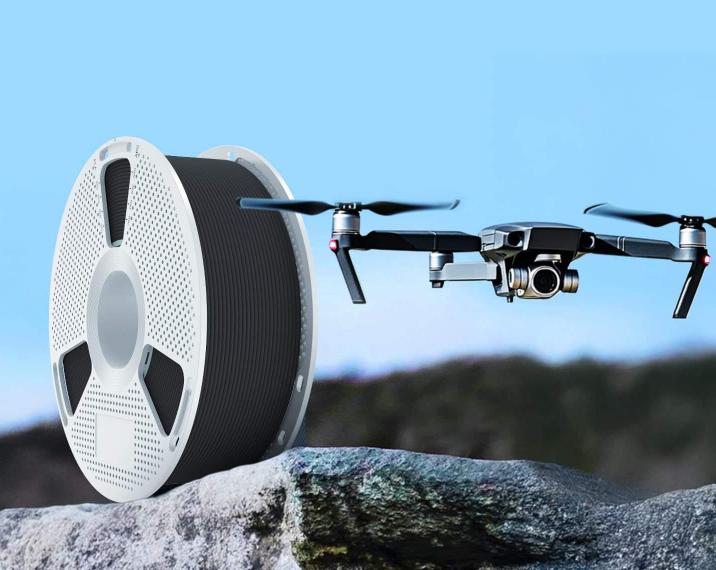
Moreover, carbon fiber offers an excellent stiffness-to-weight ratio, allowing designers to reduce component weight while maintaining the required structural performance. This is particularly valuable in robotics, drones, automotive applications, and lightweight manufacturing equipment.
Why Can the Same Carbon Fiber Filament Produce Different Results?
A filament’s data sheet describes material potential under specific test conditions. Still, the performance of an actual 3D-printed part can be very different because FDM printing creates a layered and direction-dependent structure.
During extrusion, chopped fibers tend to align with the direction of material flow. This can improve strength and stiffness along the printed path. However, the bonds between layers are still mainly created by the thermoplastic matrix. As a result, a part may be strong along the XY plane but considerably weaker in the Z direction.
Part orientation is therefore critical. Load-bearing features should be positioned so that major forces follow the strongest print paths whenever possible. A poorly oriented component can fail between layers even when it is made from a high-quality carbon fiber material.
Temperature also affects performance. If the nozzle temperature is too low, the material may not fuse properly, leading to weak layer adhesion and internal gaps. A suitable heated bed and controlled build environment can reduce thermal stress, warping, and premature separation.
Moisture is another major concern, especially with carbon fiber nylon. Hygroscopic materials absorb water from the air. Wet filament may create bubbles, rough surfaces, inconsistent extrusion, and weaker parts. Drying the filament before printing and storing it in a sealed dry box can significantly improve reliability.
Because carbon fiber is abrasive, a standard brass nozzle can wear quickly. A hardened steel, ruby, or other wear-resistant nozzle is usually required. A larger nozzle diameter may also reduce clogging and improve extrusion consistency, depending on the fiber length and material formulation.
How to Get the Best Performance in Real Applications
Successful carbon fiber 3D printing begins with selecting the right matrix polymer.
Carbon fiber PETG contains 10% carbon fiber, offering high strength and excellent toughness.Carbon fiber PETG may be sufficient for stable fixtures and machine accessories, while carbon fiber PA is often preferred for functional components requiring better toughness.
Part design should reflect the realities of additive manufacturing. Sharp internal corners can concentrate stress, while thin walls and sudden changes in section thickness may create weak points. Adding fillets, using appropriate wall thickness, and reinforcing critical areas can improve durability without greatly increasing weight.
Print settings should be validated rather than copied without testing. Nozzle temperature, chamber temperature, layer height, print speed, wall count, and infill strategy all influence the final component. For critical applications, test coupons printed in the intended orientation can help confirm mechanical performance before production.
Post-processing may also be useful. Annealing can improve heat resistance and dimensional stability for certain materials, although it may cause shrinkage or distortion. Machining, threaded inserts, and protective coatings can help printed parts meet assembly and environmental requirements.
Conclusion
Carbon fiber 3D printing filament can offer higher stiffness, better dimensional stability, and a strong stiffness-to-weight ratio compared with many unfilled polymers. However, these advantages do not come from the carbon fiber alone. The matrix polymer, fiber characteristics, part orientation, print settings, moisture control, and part design all influence the performance of the final component.
To get consistent results, choose a carbon fiber filament that matches the application and validate the printing conditions for your specific material and printer. With the right combination of material selection, preparation, and printing practices, carbon fiber reinforced filaments can be a practical choice for lightweight, rigid, and dimensionally stable parts.
If you are looking for reliable materials for your next project, explore the carbon fiber 3D printing filaments at SUNLU and find a material suited to your printing and application requirements.