

The extrusion system of an FDM printer typically consists of a filament feeding mechanism, a heating unit, a nozzle, and a cooling fan.
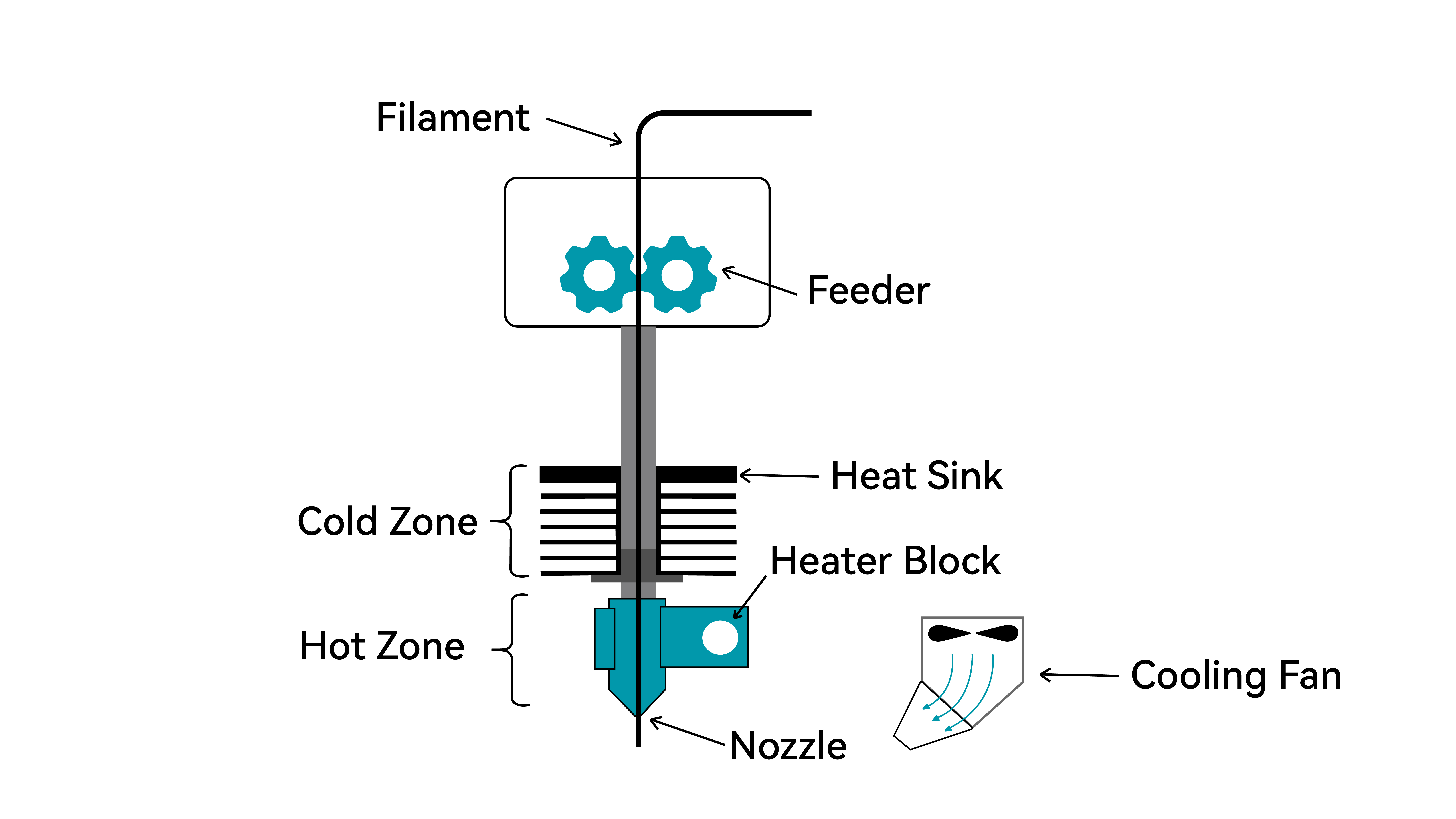
Filament Feeding Mechanism (Cold Zone)
Also known as the cold zone, the filament feeding mechanism is the driving force of the extrusion system. It is responsible for pushing solid filament into the hotend in a stable and controlled manner.
Typical components:
- Stepper motor: Provides precise rotational motion, enabling both forward (extrusion) and reverse (retraction) movement.
- Drive gear: Directly contacts the filament; its teeth grip the filament surface to generate pushing force.
- Idler gear (or idler wheel): Presses the filament from the opposite side to prevent slipping.
- Tension adjustment mechanism: Adjusts the pressure applied by the idler gear to accommodate different filament types and diameters.
Heating Unit (Hot Zone)
Also known as the hot zone, this component melts solid filament, making it pliable and allowing it to be extruded smoothly through the nozzle to effectively bond with adjacent layers.
Typical components:
- Heater block: Usually made of aluminum for good thermal conductivity and moderate heat capacity; houses the heater cartridge and temperature sensor
- Heater cartridge: A resistive heating element that generates heat when powered, raising the heater block to the target temperature
- Temperature sensor (thermistor): Monitors the temperature in real time and sends feedback to the control board for PID temperature regulation
- Heat break: Located between the heater block and heatsink, typically made of stainless steel or titanium to stop heat from moving upwards
Nozzle
The nozzle is where the molten material is extruded, determining the width and precision of the printed lines.
| Parameter | Typical Range | Description |
| Orifice diameter | 0.2mm – 0.8mm | 0.4 mm is the most common, balancing speed and detail |
| Material | Brass / Stainless steel / Hardened steel / Ruby-tipped | Brass is general-purpose; hardened steel is ideal for abrasive materials like carbon fiber or glass fiber |
| Structure | Integrated / Replaceable tip | Replaceable designs allow easier maintenance and swapping |
Hotend Cooling Fan
The hotend cooling fan is mounted on the heatsink (cold end side) and provides active cooling within the extrusion system. Its function is to continuously cool the heatsink, keeping the filament solid and rigid before it enters the hotend.
This prevents heat from creeping upward into the feeding mechanism, which could otherwise soften or deform the filament prematurely. The hotend fan typically runs at full speed whenever the printer is powered on and should not be turned off.
Working Principle:
Heat from the heater block naturally moves upward through its metal components. The heatsink, with its large surface area, works together with the cooling fan to dissipate this heat and to maintain a lower temperature.
As a result, the filament remains solid while passing through the heatsink region and only begins to melt once it reaches the heater block.
Common Issues:
Hotend fan failure → Heat creep causes the filament to soften prematurely, leading to clogs (often observed as extrusion stopping mid-print)
Insufficient fan speed → Inadequate cooling can also result in clogging due to poor heat dissipation