

Material extrusion is an additive manufacturing process in which material is heated through a nozzle to a molten or semi-fluid state. A motion system follows a predefined path to control the extrusion of material, depositing it layer by layer and allowing it to solidify into a three-dimensional structure.
This process is centered on continuous material extrusion and is compatible with a wide range of materials, including thermoplastics, metal and ceramic slurries, and even concrete. Overall, this process features relatively simple equipment structure, low cost, and ease of implementation, making it one of the most widely adopted 3D printing technologies today.
Fused Deposition Modeling (FDM)
Fused Deposition Modeling (FDM, registered trademark of Stratasys) is a material extrusion-based 3D printing process, also referred to by the alternative names "FFF", "FFM", and "PJP". It is one of the most widely adopted 3D printing technologies in both consumer and professional environments.
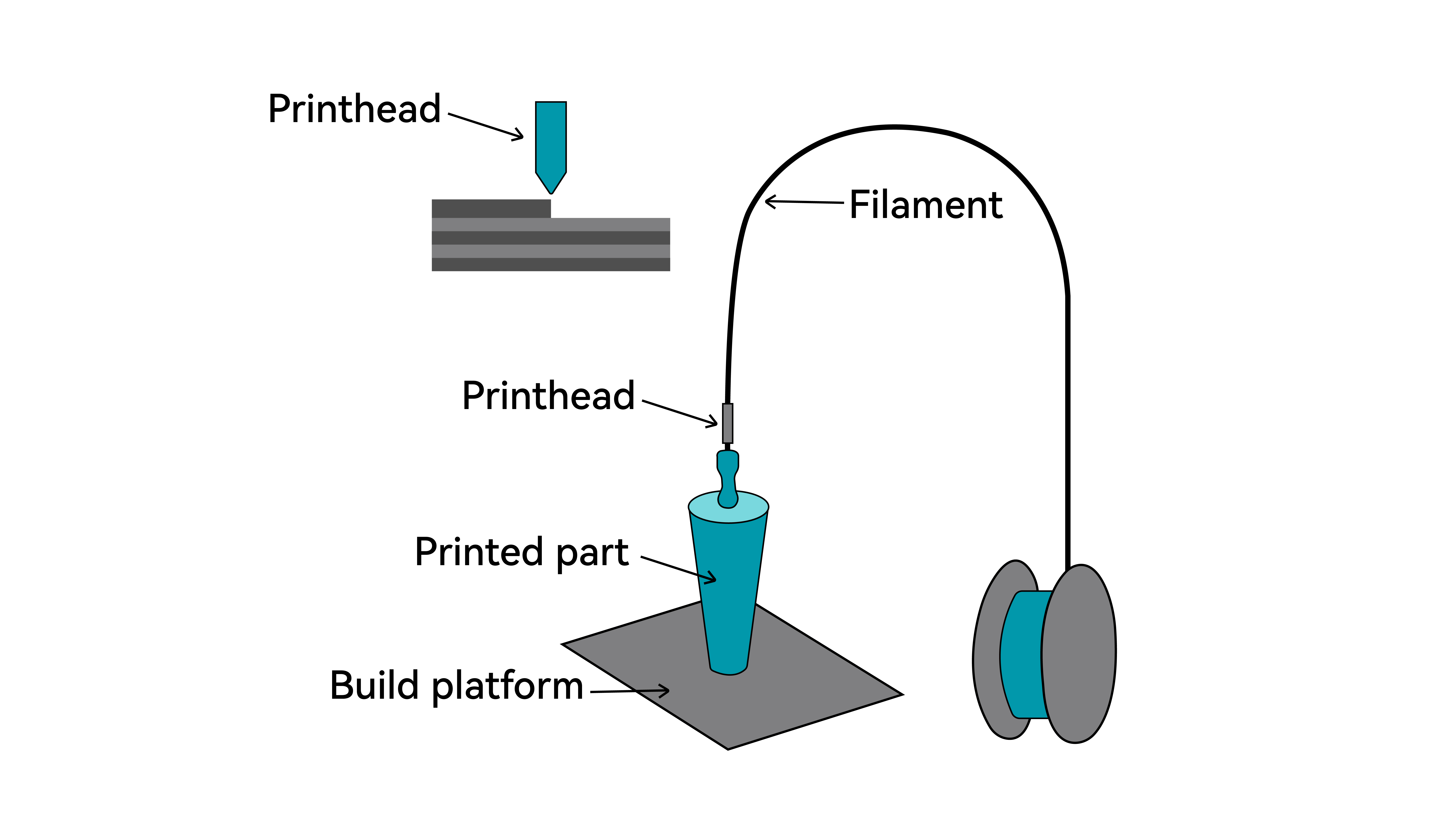
The process uses thermoplastic filament as feedstock. During printing, the filament is fed into a heated hot end where it is melted and extruded through a nozzle. The print head moves along programmed toolpaths in the X–Y plane, depositing molten material onto the build surface or previously printed layers. After deposition, the material cools and solidifies, forming a bond with the underlying layer.
Once a layer is completed, the system shifts along the Z-axis by a predefined layer height, and the next layer is deposited. This layer-by-layer process continues until the final three-dimensional object is formed.
Key Characteristics of FDM
Advantages
1. Accessible and Cost-Effective
FDM is one of the most widely adopted 3D printing technologies due to its straightforward mechanical design and relatively low system cost. Both printers and filament materials are generally affordable and easy to maintain.
2. Wide Material Availability
A broad range of thermoplastic filaments is available, including PLA, ABS, PETG, nylon, and flexible materials. This variety allows FDM to cover applications from visual prototypes to functional parts.
3. Clean and Practical Operation
Compared to resin or powder-based technologies, FDM systems are easier to operate and typically require less post-processing. When properly ventilated, they are suitable for home, educational, and office environments.
4. Efficient for Prototyping and Iteration
Because no molds or tooling are required, design changes can be implemented quickly, making FDM well suited for rapid prototyping and small-batch production.
Limitations
1. Visible Layer Lines
The layer-by-layer extrusion process naturally produces visible layer lines. Surface finishing may be required for applications where appearance is critical.
2. Limited Fine Detail
Print resolution is influenced by nozzle diameter and layer height. Very small features and sharp details may be more difficult to reproduce compared to photopolymer-based technologies.
3. Mechanical Anisotropy
Since parts are built in layers, bonding between layers is typically weaker than within each layer. Print orientation should therefore be considered when designing load-bearing components.
4. Print Speed Constraints
Large solid models or high infill settings can result in long build times due to the sequential deposition process.
FDM Process Workflow
1. Material Preparation
FDM uses thermoplastic filament as its raw material, typically supplied on spools with diameters of 1.75 mm or 2.85 mm. Common materials include PLA, PETG, and ABS. Filament must be kept dry before printing. Moisture can cause issues such as bubbling, stringing, and poor layer adhesion. It is recommended to store filament in a dry box or to dry it prior to use.
2. Heating and Melting
The filament is fed into the print head (hotend assembly) by the feeding mechanism. It enters the heating zone near the nozzle, where the temperature is raised above the material’s melting point (typically 180–400°C, depending on the material), transforming the solid filament into a viscous, flowable state.
3. Extrusion and Deposition
The molten material is continuously extruded through a small nozzle opening (typically 0.2–0.6 mm in diameter). It is deposited onto the build plate or previously printed layers, forming a three-dimensional object through layer-by-layer stacking and cooling.
4. Interlayer Bonding
After deposition, the extruded material rapidly cools and partially solidifies. The heat from newly extruded material slightly remelts the surface of the previous layer, enabling thermal bonding between layers and forming a cohesive structure.
5. Post-Processing
After printing, parts usually require post-processing to meet final application requirements. Common methods include support removal, sanding, bonding, and annealing.
Fused Granular Fabrication (FGF)
FGF is an additive manufacturing process based on thermoplastic melt deposition. Unlike FDM, which uses filament, FGF directly utilizes thermoplastic pellets.
Pellets are fed into a hopper, melted in a heated chamber, and driven by a screw mechanism before being extruded through a nozzle.
FGF can use injection-grade pellets directly without converting them into filament, significantly reducing processing time and material cost. The use of pellets also enables higher extrusion flow rates, making FGF particularly suitable for large-scale plastic parts.
Key Features of FGF 3D Printing
Advantages
- Lower material cost: Direct use of injection-grade pellets eliminates filament production costs.
- Flexible material selection: Supports reinforced (glass fiber/carbon fiber), flame-retardant, anti-static, and even recycled materials.
- Large-format printing capability: Commonly used in industrial-scale 3D printers.
- High extrusion efficiency: Screw-based extrusion enables high flow rates, ideal for fast production of large parts.
Limitations
- Lower precision and surface quality: Larger nozzle diameters typically result in rougher surfaces.
- Material and process constraints: Requires good pellet flowability; fine or agglomerated particles may cause unstable feeding or clogging. Material switching can be difficult and wasteful.
- Higher equipment requirements: Machines are usually large, expensive, and require industrial power and compressed air. Maintenance is more complex due to components such as screws, nozzles, and cooling systems.
FGF Process Workflow
1. Material Preparation
Most pellets must be pre-dried in a drying oven to remove moisture. Ensure uniform particle size and absence of dust or clumping before loading into the hopper or conveying system.
2. Heating and Melting
Pellets are transported by a rotating screw into the barrel, which contains one or more heating zones. The material is gradually melted into a uniform blend, while the screw mixes it thoroughly to ensure consistency.
3. Extrusion and Deposition
Pellets enter the barrel through the hopper and are conveyed forward by the rotating screw. As they pass through segmented heating zones, they are melted, compressed, and homogenized, then continuously extruded through the nozzle under pressure.
4. Interlayer Bonding
When the newly extruded high-temperature material contacts the previously solidified layer, localized remelting occurs on contact. This enables thermal bonding between layers, forming a unified structure.
5. Post-Processing
Due to larger nozzle diameters and thicker layers, FGF parts often have rough surfaces and visible layer lines. Post-processing is typically required, including cleaning, sanding, heat treatment, and painting.